
Blog EN


The refractory industry is undergoing a quiet yet profound transformation. It is no longer enough to develop materials that simply “withstand heat”; today’s demand for greater energy efficiency and lower operating costs has driven the development of highly engineered solutions.
In this article, we explore how technological advances in heat treatment processes and refractory concretes are redefining productivity standards in industrial equipment operating in high-temperature industries.
The evolution of materials: from traditional solutions to nanotechnology
For decades, refractory concretes were based on high-cement-content formulations. However, modern research has led to the development of low-cement castables (LCC), ultra-low-cement castables (ULCC) and cement-free castables.
What do these new technologies offer?
- Lower porosity: reducing the binder content results in a denser structure, making it more difficult for slags and molten metals to penetrate the material.
- Greater mechanical strength: these materials withstand abrasive wear more effectively, extending the service life of the lining.
- Nanotechnology: the incorporation of silica microparticles and nanostructured aluminium oxides makes it possible to create more compact matrices that can improve either thermal conductivity or insulation performance, depending on the requirements of each application.
This evolution in refractory materials enables more efficient and faster heat treatments, as the internal structure of the concrete is designed to withstand temperature gradients that previously could have caused premature failure.
Automation and precision in heat treatments – refractory dry-out
One of the areas where technology has had the most visible impact is process control. The traditional reliance on operator judgement has been replaced by automated control systems and intelligent curing processes.
Today, refractory drying and sintering heat treatments are managed through software capable of monitoring dozens of temperature points in real time. This makes it possible to create optimised heating curves that remove both physical and chemically bound water from the concrete without generating damaging internal stresses.
Through INTEC-HEAT, we integrate these advanced systems into our projects to ensure that the drying process is not only safe but also energy efficient, significantly reducing plant start-up times.
Sustainability and carbon footprint
Technological advances cannot be discussed without considering sustainability. New refractory lining designs pursue two key objectives: durability and thermal efficiency.
An advanced refractory concrete provides improved insulation, which means that the furnace loses less heat to the surrounding environment. This translates directly into lower fuel consumption and reduced CO2 emissions.
In addition, research is being conducted into the incorporation of recycled raw materials into refractory matrices, helping to close the material life cycle and promote more sustainable industrial solutions.

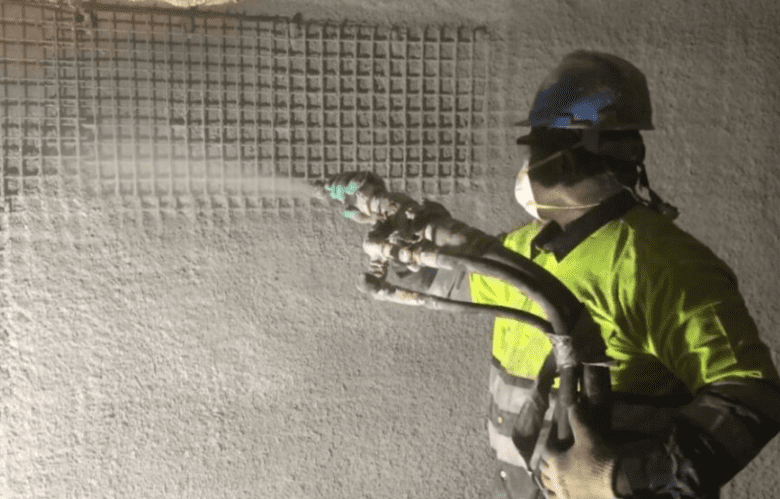
Pumped concrete is one of the most widely used installation techniques in civil construction, but in the industrial sector — especially in high-temperature environments — its role goes much further. When the material being pumped is refractory concrete, we are dealing with a technology capable of protecting equipment under conditions that no other installation method can address with the same level of efficiency.
In this article, we explain what pumped concrete is, how the pumping process works, its advantages over traditional methods and the technical requirements it must meet when applied across different industries.
What is pumped concrete?
Pumped concrete is concrete that, once the mixture has been prepared, is transported under pressure through a rigid or flexible pipeline to the pouring point, without the need for auxiliary lifting or transport equipment. The pressure is generated by a pump that continuously pushes the fresh material from the loading hopper to the outlet nozzle.
In conventional construction, this technique is used to place structural concrete at height, in hard-to-reach areas or in large volumes within tight timeframes.
The difference between conventional and refractory applications is not only the material itself, but also the technical demands involved. While structural concrete must meet mechanical strength requirements at ambient temperature, pumped refractory concrete must retain its integrity at extreme temperatures, withstand severe thermal cycling, resist abrasion caused by suspended materials and endure chemical attack from slags, gases or molten metals.
How does the pumping process work?
The installation process for pumped refractory concrete generally follows these stages:
- Mix preparation. The refractory concrete is mixed in a mixer using the quantity of mixing liquid specified by the manufacturer. The liquid-to-mix ratio is critical: too much liquid reduces the mechanical and refractory properties, while too little can prevent pumping and cause pipeline blockages.
- Loading into the pump. The fresh mixture is transferred to the pump feed hopper. The most commonly used equipment in refractory applications is the piston pump, which provides constant pressure and is more tolerant of high-viscosity mixes than other types of pump.
- Pipeline transport. The wet concrete moves through the pipeline — which may extend for dozens of metres both horizontally and vertically — until it reaches the outlet nozzle. Lubricating the internal walls of the pipeline before pumping begins is essential to prevent blockages.
- Pouring and finishing. At the outlet nozzle, the operator directs the material towards the formwork or installation area. After pouring, optimum vibration is carried out, mainly using immersion vibrators. The expertise of the installation team is essential to eliminate trapped air and bubbles from the final mix.
- Curing and drying. Pumped refractory concrete requires a controlled curing and staged drying protocol before being put into service. Thermal drying treatments gradually remove free and chemically bound water in order to prevent the build-up of steam pressure, which could crack the lining during the first heating cycle.
Advantages of pumped concrete over traditional methods
Fewer personnel and reduced risk
A pumped installation requires fewer operators than conventional vibration casting. This reduces manual handling and directly decreases the likelihood of workplace accidents.
Faster installation
Pumping makes it possible to cover large lining surfaces in significantly less time than manual vibration casting. By eliminating material transport using buckets or cranes, pouring can continue uninterrupted and overall installation productivity increases considerably.
Access to hard-to-reach areas
The flexibility of the hose makes it possible to reach areas inside equipment that would be impossible to access with conventional pouring systems. This versatility is particularly valuable during maintenance shutdowns, when intervention time is a critical factor for plant operations.
Homogeneous lining
When the refractory concrete formulation is appropriate, pumping ensures uniform material distribution without aggregate segregation, something that is difficult to achieve in large manual installations. A homogeneous lining provides more predictable and controlled service life.
Thermomechanical performance comparable to vibration casting
Not all refractory concretes are pumpable, and not every pumpable concrete is suitable for every industrial application. The main parameters that determine whether a refractory concrete is suitable for pumping are:
- Consistency and rheology. The mix must h

An industrial project can involve multiple disciplines, suppliers, technical teams and execution phases. Coordinating all these elements represents a significant challenge for any company, especially when deadlines are tight, safety requirements are demanding or production downtime needs to be kept to a minimum.
A turnkey service simplifies this process by providing a comprehensive solution managed by a single supplier. From the initial analysis and engineering to installation, commissioning and after-sales support, every stage is carried out under a single coordinated approach.
At Alfran, we have the experience, resources and specialised companies required to manage industrial projects comprehensively, adapting to the specific needs of each facility.
What is a turnkey service?
A turnkey service is a project management model in which one company assumes overall responsibility for the project, coordinating its different stages until the client receives a completed solution that is ready for operation.
The client defines their needs, objectives and technical requirements, while the supplier is responsible for organising the resources, professionals, materials and processes required to carry out the work.
This does not mean that the client is excluded from the process. Continuous communication is maintained throughout the project to review progress, address requirements and ensure that the final solution meets the agreed criteria.
In the industrial sector, a turnkey service can be applied to new-build projects as well as extensions, repairs, plant upgrades or major maintenance shutdowns.
What does an industrial turnkey service include?
The scope depends on the characteristics of each project, but a comprehensive solution may include the following stages:
- Needs assessment
The first step is to understand the facility, its operating conditions and the client’s objectives.
This initial assessment makes it possible to identify technical requirements, potential risks, access limitations, safety conditions and opportunities to improve the performance of the facility.
- Engineering and solution design
Following the initial analysis, a technical proposal tailored to the project is developed.
At this stage, materials, systems, human resources, installation procedures, safety measures and execution times are defined. Proper planning is essential to prevent incidents and optimise the subsequent development of the work.
- Manufacturing and supply
A turnkey service may also include the manufacture, selection and supply of the required materials and components.
Centralising this phase facilitates quality control, improves coordination between teams and ensures that each element complies with the technical specifications of the project.
- Installation and execution
Specialised teams carry out the work in accordance with the established planning and the corresponding quality and safety procedures.
In industrial environments, this coordination is particularly important, as work may need to be performed while facilities remain operational or during scheduled shutdowns with very limited timeframes.
- Supervision, testing and commissioning
Before the project is considered complete, the necessary checks are carried out to verify that the work has been executed correctly.
The objective is not simply to complete an installation, but to deliver an operational solution that meets the technical and performance requirements defined at the outset.
- Maintenance and after-sales support
A truly comprehensive solution does not necessarily end with project delivery. Ongoing support, inspections, maintenance and technical assistance help preserve the performance of the facility and extend its service life.
Applications in high-temperature facilities
Turnkey projects are particularly useful in industries operating high-temperature processes that require specialised technical solutions.
Potential applications include refractory linings, industrial thermal insulation, passive fire protection, heat treatments and other solutions related to equipment protection and efficiency.
These solutions can be used in sectors such as:
- Cement and lime.
- Steel.
- Non-ferrous metals.
- Energy.
- Oil and gas.
- Chemical and petrochemical industries.
- Glass.
- Incineration and biomass.
Each sector operates under different conditions. For this reason, the service must be designed taking into account temperatures, chemical attack, me