



Choosing the right refractory material for industrial equipment is essential to ensure safety, efficiency and continuity of the production process. These materials protect the equipment structure against high temperatures, but they must also withstand abrasion, impact, thermal changes and possible chemical attack.
For this reason, selection cannot be based solely on the maximum operating temperature. Each piece of equipment and each area of the installation operates under different conditions that must be analysed before designing the lining.
The composition of the processed material, the internal atmosphere, heating and cooling cycles and the installation system all have a direct influence on the performance and service life of the refractory concrete.
What is a refractory material for industrial equipment?
A refractory material is one that is capable of maintaining its physical and chemical properties when exposed to high temperatures and extreme industrial conditions.
In industrial equipment, the refractory creates a barrier between the thermal process and the equipment structure. Its main function is to protect walls, roofs and other components from heat, gases, slags or molten materials.
A properly designed lining also helps to:
- Improve installation safety.
- Reduce heat losses.
- Maintain a stable process temperature.
- Resist abrasion and erosion.
- Prevent chemical and corrosive attack.
- Extend equipment service life.
- Reduce maintenance requirements.
Refractory materials should therefore be understood as an essential part of equipment operation, rather than simply as a heat-resistant coating.
Types of refractories for industrial equipment
Refractory materials can mainly be classified according to their chemical composition, format, density or installation method.
Acid refractories
These are mainly manufactured from materials such as silica and are used in environments where resistance to acidic chemical attack is required.
To ensure proper performance, contact with basic substances that could cause reactions and accelerate deterioration must be avoided.
Basic refractories
These are mainly formulated from raw materials such as magnesia. They provide resistance to high temperatures and to slags or chemically basic environments.
They are commonly used in different metallurgical processes and in installations exposed to particularly aggressive chemical conditions.
Neutral refractories
This category includes materials based on alumina or silicon carbide. They are characterised by their thermal, mechanical and chemical resistance, making them suitable for a wide range of industrial applications.
This classification provides an initial reference point. The final choice must always be based on the specific operating conditions of each piece of equipment.
Refractory bricks and castables
Another classification distinguishes between shaped and unshaped refractory materials.
Shaped materials, such as bricks and precast components, are manufactured in advance with specific dimensions. Bricks provide dimensional stability and allow localised replacement during repairs. However, their installation requires proper joint design and consideration of movement caused by thermal expansion.
Precast components are particularly useful in areas with complex geometries or where intervention times need to be reduced.
Monolithic refractory castables are unshaped materials that take their final form during installation. They make it possible to create continuous linings and adapt to different geometries.
Depending on the project, they can be installed by pouring, vibration casting, pumping, dry gunning or wet spraying. These methods make it possible to work on large surfaces and reduce the number of joints, although their performance depends both on product quality and on correct installation.
How to choose the right refractory
There is no single refractory material suitable for every piece of equipment. Selection must begin with a technical analysis of the process and the actual operating conditions.
Temperature and operating cycles
It is necessary to know the normal operating temperature, possible maximum values and the duration of each cycle. Heating and cooling rates must also be assessed.
Sudden temperature changes generate internal stresses that can cause cracking or spalling. Equipment exposed to frequent start-up and shutdown cycles therefore requires materials with good thermal shock resistance.
Chemical conditions
The refractory material may come into contact with gases, alkalis, slags, ash, fuels or molten metals.
Chemical compatibility between the refractory and these elements is essential. A refractory with high temperature resistance may deteriorate rapidly if it reacts with substances present in the process.
Abrasion and mechanical stress
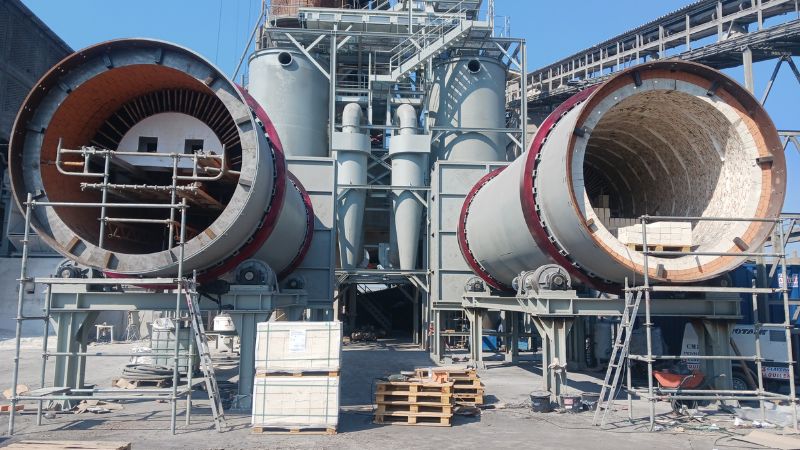
In rotary kilns, coolers, boilers or ducts, the lining may be exposed to the continuous movement of solid materials.
These areas require solutions capable of withstanding impact, vibration, erosion and mechanical wear without losing thickness prematurely.
Insulation and energy efficiency
Thermal conductivity determines how much heat passes through the lining. Dense materials are generally used in areas in direct contact with the process, while insulating materials reduce thermal losses and protect the external structure.
For this reason, many types of equipment use multilayer linings in which each layer performs a different function.
Installation system and available time
Geometry, wall orientation, access conditions and the time available during a plant shutdown all influence the choice of installation method.
Systems such as pumping or spraying can increase installation productivity in certain applications. However, the installation procedure must always be selected together with the refractory material.
It is also important to assess cost over the entire service life. The solution with the lowest initial price is not always the most cost-effective if it requires frequent repairs or causes unplanned shutdowns.
The importance of professional installation
Even a high-performance material can fail if it is not installed correctly.
Surface preparation, anchor design, water dosage, mixing, compaction and curing all directly affect the final result. Errors during any of these stages can lead to weak areas, excessive porosity, cracking or premature spalling.
At ALFRAN, we have different technologies adapted to the characteristics of each project. These include ALFRANJET®, our proprietary and patented wet-spraying system for refractory castables.
Curing and drying of the lining
After installing refractory concrete, the required curing period must be respected and an appropriate drying curve must be applied.
During this process, the water contained in the material is removed in a controlled manner. If the temperature rises too quickly, steam can accumulate and create internal pressures capable of causing cracking, spalling or explosive spalling.
The drying curve must define heating ramps and holding times at each temperature. Its design will depend on the type of material, its density, lining thickness, number of layers and equipment geometry.
Refractory maintenance
Regular inspections make it possible to detect cracks, thickness loss, hot spots or damaged areas before a major failure occurs.
Visual inspection can be supplemented with infrared thermography to identify temperature differences on the external surface. Based on this diagnosis, a localised repair, relining or complete lining replacement can be planned.
Integrating these interventions into scheduled shutdowns reduces the risk of unexpected interruptions and helps extend equipment service life.
Refractory solutions for industrial equipment
At ALFRAN, we develop solutions covering refractory lining engineering, material manufacturing and supply, installation, drying and maintenance.
This approach makes it possible to assess the equipment as a complete system and coordinate the different project stages according to common quality, safety and performance criteria.
Choosing the right refractory material protects the equipment, improves thermal efficiency and reduces maintenance requirements. Achieving this requires the combination of high-performance materials, specialised engineering, professional installation and proper lining monitoring.
Contact our team to assess the requirements of your industrial equipment and identify the refractory solution best suited to your process.