



Pumped concrete is one of the most widely used installation techniques in civil construction, but in the industrial sector — especially in high-temperature environments — its role goes much further. When the material being pumped is refractory concrete, we are dealing with a technology capable of protecting equipment under conditions that no other installation method can address with the same level of efficiency.
In this article, we explain what pumped concrete is, how the pumping process works, its advantages over traditional methods and the technical requirements it must meet when applied across different industries.
What is pumped concrete?
Pumped concrete is concrete that, once the mixture has been prepared, is transported under pressure through a rigid or flexible pipeline to the pouring point, without the need for auxiliary lifting or transport equipment. The pressure is generated by a pump that continuously pushes the fresh material from the loading hopper to the outlet nozzle.
In conventional construction, this technique is used to place structural concrete at height, in hard-to-reach areas or in large volumes within tight timeframes.
The difference between conventional and refractory applications is not only the material itself, but also the technical demands involved. While structural concrete must meet mechanical strength requirements at ambient temperature, pumped refractory concrete must retain its integrity at extreme temperatures, withstand severe thermal cycling, resist abrasion caused by suspended materials and endure chemical attack from slags, gases or molten metals.
How does the pumping process work?
The installation process for pumped refractory concrete generally follows these stages:
- Mix preparation. The refractory concrete is mixed in a mixer using the quantity of mixing liquid specified by the manufacturer. The liquid-to-mix ratio is critical: too much liquid reduces the mechanical and refractory properties, while too little can prevent pumping and cause pipeline blockages.
- Loading into the pump. The fresh mixture is transferred to the pump feed hopper. The most commonly used equipment in refractory applications is the piston pump, which provides constant pressure and is more tolerant of high-viscosity mixes than other types of pump.
- Pipeline transport. The wet concrete moves through the pipeline — which may extend for dozens of metres both horizontally and vertically — until it reaches the outlet nozzle. Lubricating the internal walls of the pipeline before pumping begins is essential to prevent blockages.
- Pouring and finishing. At the outlet nozzle, the operator directs the material towards the formwork or installation area. After pouring, optimum vibration is carried out, mainly using immersion vibrators. The expertise of the installation team is essential to eliminate trapped air and bubbles from the final mix.
- Curing and drying. Pumped refractory concrete requires a controlled curing and staged drying protocol before being put into service. Thermal drying treatments gradually remove free and chemically bound water in order to prevent the build-up of steam pressure, which could crack the lining during the first heating cycle.
Advantages of pumped concrete over traditional methods
Fewer personnel and reduced risk
A pumped installation requires fewer operators than conventional vibration casting. This reduces manual handling and directly decreases the likelihood of workplace accidents.
Faster installation
Pumping makes it possible to cover large lining surfaces in significantly less time than manual vibration casting. By eliminating material transport using buckets or cranes, pouring can continue uninterrupted and overall installation productivity increases considerably.
Access to hard-to-reach areas
The flexibility of the hose makes it possible to reach areas inside equipment that would be impossible to access with conventional pouring systems. This versatility is particularly valuable during maintenance shutdowns, when intervention time is a critical factor for plant operations.
Homogeneous lining
When the refractory concrete formulation is appropriate, pumping ensures uniform material distribution without aggregate segregation, something that is difficult to achieve in large manual installations. A homogeneous lining provides more predictable and controlled service life.
Thermomechanical performance comparable to vibration casting
Not all refractory concretes are pumpable, and not every pumpable concrete is suitable for every industrial application. The main parameters that determine whether a refractory concrete is suitable for pumping are:
- Consistency and rheology. The mix must have sufficient viscosity to flow under pressure without segregating, while not being so fluid that it loses cohesion during transport or pouring.
- Working time. The material must retain its pumpability for long enough to complete the installation, particularly in large-volume projects.
- Cement content. Low-cement and cement-free systems offer better performance at high temperatures due to the reduced formation of low-refractoriness phases, although their mix design requires more precise control.
- Chemical compatibility. The refractory material must be chemically compatible with the process environment to which it will be exposed, such as basic or acidic slags, reducing atmospheres, sulphur-containing gases and other aggressive conditions.
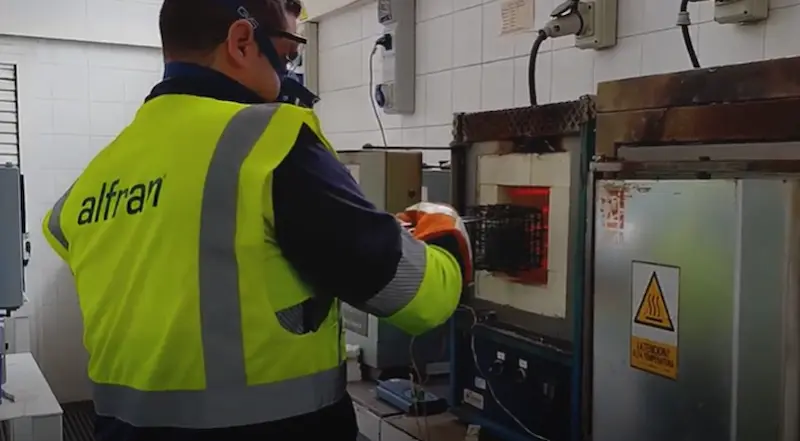
Pumped refractory concrete: common industrial applications
Cement industry
In cement plants, pumped refractory concrete is used to line areas such as heat exchanger cyclones and calciners, among others.
Steel industry
In rolling process equipment, pumped concrete enables refractory linings to be repaired quickly. Shutdown times are critical in steelmaking, and pumping is one of the few techniques that allows work to be completed within the short timeframes available between production campaigns.
Aluminium and non-ferrous metals
Aluminium melting, holding and treatment furnaces often feature complex geometries and hard-to-reach areas, making pumping an ideal installation technique. The refractory concretes used must also resist attack from molten aluminium.
Energy and biomass
Boilers, incinerators and biomass plants use pumped refractory concrete to protect areas exposed to the highest temperatures and wear levels. The technique makes it easier to access the irregular geometries that are common in these types of installations.
Alfranpump: high-performance pumped refractory concrete
At alfran®, we have been developing high-temperature solutions for the world’s most demanding industries for more than 80 years. Our alfranpump range includes low-cement and cement-free refractory concretes specifically formulated for pumping using Pumpcrete technology.
alfranpump refractory concretes deliver thermomechanical performance comparable to traditional vibration casting while providing the installation efficiency of pumping: faster application, reduced manpower requirements, lower manual handling and a homogeneous lining with a long service life.
They are primarily resistant to abrasion, erosion and chemical attack and are available in different formulations to suit the specific conditions of each process and industry.
If your plant requires a new refractory lining, a repair during a maintenance shutdown or a tailored solution for a complex geometry, our technical team can advise you on the materials to be lined and the most appropriate installation method.
Frequently asked questions about pumped concrete
What is the difference between pumped concrete and sprayed concrete?
Pumped concrete is conveyed through a pipeline to the nozzle and poured in a controlled manner into formwork or the installation area. Sprayed concrete — shotcrete or wet-mix spraying — is mixed with air and additive at the spraying nozzle and projected at high speed against the application surface.
In practice, both techniques can use the same pumping equipment; the main difference lies in the nozzle configuration and the material outlet velocity.
Do pumpable concretes have poorer refractory properties than vibration-cast concretes?
Not necessarily. Latest-generation low-cement and cement-free concretes, when correctly formulated and installed, can achieve properties equivalent to conventional systems. The key lies in the mix design and in controlling the installation process.