



Our history is also a story of transformation. A journey that began in Seville more than a century ago and has taken us from manufacturing ceramic products to developing high-temperature solutions for some of the world’s most demanding industrial sectors.
This evolution has recently come back into the spotlight following a feature published by El Correo de Andalucía, which traces the origins of Grupo Aldomer and our transformation from that first ceramics workshop in Triana, Seville, to the international company we are today.
In the article, José María Domínguez, Executive Chairman of Grupo Aldomer, discusses the evolution of a family business that has successfully applied knowledge built up over generations to new materials, technologies, markets and industrial processes.
That journey also helps explain our own evolution. Over more than one hundred years, our products, markets and technologies have changed, but our knowledge of materials and high-temperature processes has remained the common thread.
From a Ceramics Workshop in Triana to the High-Temperature Industry
Our origins date back to 1914, when Fernando Domínguez Alfaro began manufacturing ceramic materials on Calle Alfarería, in Seville’s Triana district.
That small workshop marked the beginning of a business journey that, generation after generation, evolved towards the manufacture of refractory materials and, later, the development of comprehensive services and solutions for industrial facilities operating at high temperatures.
The transformation has been profound, but there is a clear connection between these two worlds: our knowledge of materials and how they behave when exposed to heat.
Today, we work in industries such as cement, steel, metals, energy, glass and petrochemicals, where operating conditions require a combination of specialized materials, engineering, installation expertise and technical knowledge.
Because industrial companies do not survive for generations by doing exactly the same thing.
They endure because they learn how to evolve.
And we have evolved alongside industry.
Knowledge as the Starting Point
In heavy industry, very few decisions are truly minor.
The choice of a refractory material, the design of a lining or the execution of an installation can have a direct impact on equipment availability, energy consumption, maintenance requirements and service life.
That is why working with high-temperature industrial facilities requires much more than having a good product. It requires understanding the industrial process as a whole.
At Alfran, we have built our business around precisely that knowledge.
Our experience in refractory materials and high-temperature solutions enables us to approach every project while taking into account the specific operating conditions of each installation.
Temperature, abrasion, chemical attack, thermal cycles, shutdown times and process characteristics are just some of the variables that can influence the performance of a refractory solution.
Understanding them is the first step towards making better decisions.
From Manufacturing Materials to Developing Refractory Solutions
The evolution of our company also reflects a broader transformation within industry.
For decades, the relationship between manufacturers and customers focused primarily on supplying products. Today, industrial projects demand a much more comprehensive approach.
Our customers need teams capable of understanding their processes, selecting the right materials, providing engineering expertise, carrying out installations and subsequently supporting equipment maintenance and supervision.
We have evolved in that direction as well.
Over the years, we have expanded our capabilities to offer solutions covering different stages of an industrial facility’s life cycle: from design and engineering to refractory material manufacturing, installation, technical supervision and maintenance.
This integrated approach allows us to work from a broader perspective.
It is not simply about addressing an immediate need, but about contributing to the reliable long-term operation of industrial facilities.
Innovation Also Happens Inside Industrial Equipment
When we talk about industrial innovation, we often immediately think of digitalization, automation or artificial intelligence.
However, we know that an essential part of innovation takes place in much less visible environments.
It happens inside industrial equipment.
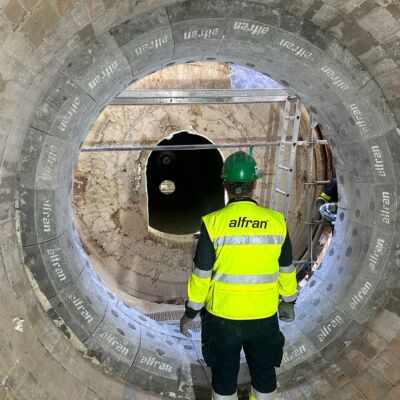
It happens when we enable a lining to withstand more demanding operating conditions. When a solution helps extend an operating campaign before a shutdown is required. When we reduce heat losses. When we improve installation times or develop a system that simplifies future maintenance work.
In industrial processes involving high temperatures, small technical improvements can generate a significant impact.
That is why we continue to invest in research, material development and the adoption of new technologies.
Our approach to innovation is not limited to the product itself. We also study how each material is applied, how it performs throughout its service life and how it can contribute to improving the overall operation of an installation.
And our refractory solutions must evolve along with them.
Growing Means Learning from Every Market
Another major chapter in our history has been our international expansion.
Working in different countries means encountering new processes, regulations, operating conditions and industrial cultures.
Every market presents its own challenges.
And that diversity itself becomes a valuable source of knowledge.
The experience we gain across different facilities, industries and geographical regions enables us to develop new capabilities and transfer lessons learned from one project to another.
For us, internationalization is not simply about being present in different countries.
It means creating teams capable of sharing experience, working in a coordinated way and maintaining the same quality and safety standards wherever we carry out a project.
It is one of the major transformations that separates that ceramics workshop founded in Triana from the company we are today.
Technology Changes. People Remain Essential
Today’s industry has access to tools that would have been difficult to imagine just a few decades ago.
Sensors, monitoring systems, data analytics, automation and new digital solutions are giving us an increasingly detailed understanding of how industrial equipment performs.
However, even in an increasingly technology-driven environment, there is one element that remains essential to us: people.
The experience of our technical teams, the knowledge acquired in the field and the ability to interpret the real operating conditions of an installation remain fundamental.
That is why our approach to innovation combines technology with human expertise.
Engineers, technicians, installers, maintenance managers and specialists work together to find the most appropriate solution for each project.
Because protecting an industrial facility begins with understanding it.
More Than One Hundred Years Evolving Alongside Industry
More than one hundred years have allowed us to change virtually everything: our products, our technologies, the markets in which we operate, the scale of our company and the countries in which we work.
But they have also allowed us to confirm which elements should remain unchanged.
Our safety culture, customer focus, technical expertise, commitment to quality and ability to adapt continue to be essential pillars of our company.
Our purpose, “We care for people and protect the heart of industry,” sums up the way we understand our work.
Today’s industrial challenges are different from those of past decades, and they will undoubtedly change again in the years ahead.
New materials, more efficient processes, digitalization, automation, decarbonization and technologies yet to be developed will continue to transform industry.
Our responsibility is to continue evolving alongside it.
Because a century-long history is not built by looking only at the past. It is built by using everything we have learned to take on the next challenge.