



Precast refractory elements have become one of the most efficient and reliable alternatives for improving the performance of industrial equipment exposed to high temperatures.
Their factory-controlled production, combined with fast installation, makes them an ideal solution for optimizing shutdown times and ensuring reliable thermal performance. Below we explore their main characteristics and benefits.
What are precast refractory concrete components and why are they gaining importance?
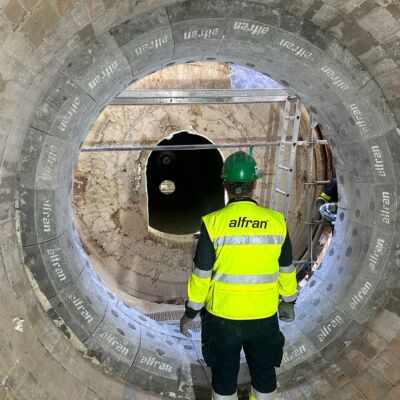
Precast refractory products are pieces that are molded and cured in advance under controlled conditions.
Thanks to this process, they provide high mechanical performance, thermal stability and uniformity, reducing the errors and variations commonly associated with installations carried out entirely on site.
They are especially used in critical areas of furnaces, chambers, ducts, cyclones or equipment with geometries that require high precision.
Key advantages compared to traditional refractory installations
Higher quality and uniformity
Industrial manufacturing ensures a homogeneous mix, proper curing and consistent properties in every piece. This results in improved thermal performance and longer service life.
Reduced shutdown times
Installation is significantly faster because the components arrive ready to be assembled. In industries where every hour matters, this represents considerable operational cost savings.
Improved on-site safety
Tasks performed at height or in hard-to-access areas are minimized, reducing occupational risks during installation.
Excellent resistance to thermal shock
Precast elements are designed to withstand demanding thermal cycles, preventing cracks and premature failures.
![]()
 Common applications of precast refractory components
Among many others, they are commonly used in:
- Cyclone linings in the cement industry
- Channels and nozzles in metallurgical processes
- Combustion chambers and burner areas
- Plates, slabs or panels for industrial furnaces
- Special components for complex geometries or high-wear areas
These elements allow critical areas to be reinforced without the need to replace entire refractory linings.
Factors to consider when choosing a precast refractory component
- Type of process and maximum operating temperature
- Chemical environment (abrasion, corrosion, reducing atmospheres…)
- Thermal cycles and frequency of start-ups/shutdowns
- Compatibility with existing materials
- Geometric design and required anchoring systems
Proper selection ensures optimal performance and efficient integration with the rest of the thermal system.
Precast refractory elements represent a strategic solution for improving safety, reducing shutdown times and increasing thermal efficiency in industrial equipment.
Their combination of uniformity, durability and ease of installation makes them a key tool for high-demand industrial environments.