


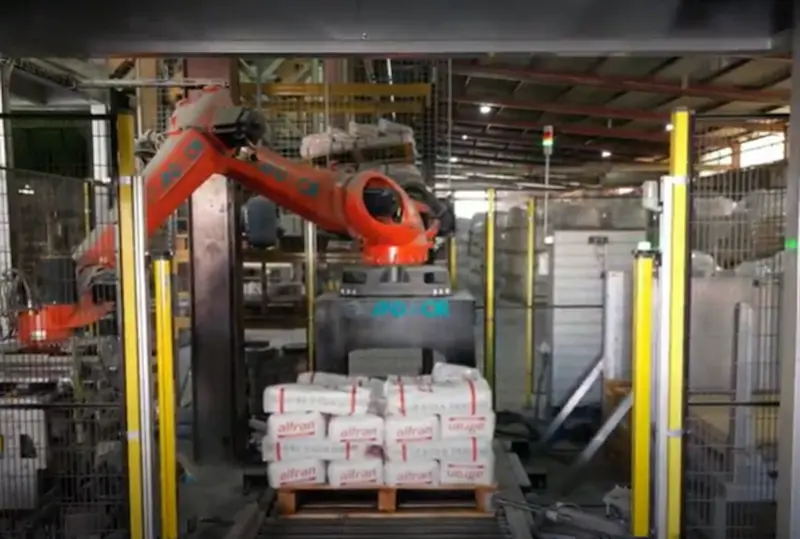
In the refractory industry, the manufacture of refractory concretes is a critical stage that directly influences the durability and performance of linings installed in furnaces, boilers, and other equipment subjected to high temperatures.
Experience gained in sectors such as cement, energy, steel, and oil & gas has shown that the challenges of this process are not only related to the selection of materials, but also to the precision of their preparation and installation.
Experience gained in sectors such as cement, energy, steel, and oil & gas has shown that the challenges of this process are not only related to the selection of materials, but also to the precision of their preparation and installation.
These aspects include the homogeneity of the mixture, the particle size of the components, the setting and drying time, and the conditions during installation of the material.
Throughout this article, we will analyze in detail the main challenges posed by the manufacture of refractory concretes and offer practical and effective solutions that we at Alfran have successfully implemented in our projects. In this way, we seek not only to anticipate failures, but also to guarantee the quality and reliability of the final product under the most demanding industrial operating conditions.
What are refractory concretes and what are they used for?
Refractory concretes are mixtures designed to withstand high temperatures, thermal shocks, chemical attacks, and mechanical stresses in the most demanding industrial applications. Composed of refractory aggregates and hydraulic or chemical binders, these materials are applied using techniques such as casting, shotcrete, pumping, or wet spraying, adapting to multiple geometries and operating conditions.
They are widely used in industries where extreme thermal conditions are common. In the cement industry, for example, they protect critical areas such as the head, cooler, and cyclones, among others; in energy, they ensure the integrity of biomass boilers and incinerators; and in the oil and gas sector, they resist chemical corrosion in reactors and chimneys. Thanks to their versatility, they are essential in protecting the heart of the industry.
Main challenges in the manufacture of refractory concretes
The manufacture of refractory concretes involves more than simply combining raw materials. Each stage of the process, from material selection to installation, presents technical challenges that can affect performance if not properly controlled.
Among the most critical challenges are the proper selection of raw materials, control of particle size, and homogeneous mixing of components. Factors such as setting and drying time, as well as specific conditions during installation, influence the thermal behavior of the material and its medium- and long-term durability.
Proper selection of raw materials: a key challenge
One of the most crucial decisions in the manufacture of refractory concretes is the selection of raw materials. Choosing aggregates with a mineralogical composition compatible with operating conditions can prevent undesirable reactions such as the formation of eutectic phases or corundum, especially in contact with molten metals, which is common in industries such as aluminum and copper.
Likewise, the use of suitable binders, whether hydraulic such as CAC (calcium aluminate cement) or chemical such as those used in Drytech® concretes, defines the reactivity of the system and its behavior in the face of intense thermal cycles. At Alfran, we prioritize high-quality raw materials that ensure optimal chemical, mechanical, and thermal resistance.
Particle size control: impact on strength and durability
The particle size distribution of solid components in refractory concrete directly affects its density, porosity, and mechanical strength. An inappropriate distribution can cause microcracks, reduce compaction, and increase permeability, compromising its durability against thermal and chemical attacks.
For this reason, in our formulations, we apply optimized particle size curves that promote maximum compaction of the material, minimizing the presence of voids and improving wear resistance. This millimeter-precise control is important for obtaining predictable and reproducible results in real industrial conditions.
Mixing and homogeneity issues
A poorly executed mix can result in a significant loss of the mechanical and thermal properties of the concrete. Non-homogeneous areas within the material act as weak points that promote the appearance of cracks, accelerating the deterioration of the coating.
The use of specific mixers, standardized mixing times, and strict moisture control are essential to ensure homogeneity. At Alfran, each batch produced is verified through laboratory testing to ensure product uniformity prior to installation.
Setting and drying time: risk of cracking
Controlling setting and drying times is another critical factor. Setting too quickly can cause internal stresses, while setting too slowly can delay projects and increase costs. Incorrect drying can lead to steam cracking or internal thermal explosions.
That’s why we apply specific drying protocols and develop products such as the Drytech® range, which enable controlled setting and safer, faster, and more efficient drying. This reduces the risk of explosions and optimizes installation times.
Difficulties during the installation process
Proper installation of refractory concrete minimizes defects such as air pockets, aggregate segregation, or insufficient vibration. These problems seriously affect the integrity of the lining, especially in critical areas exposed to erosion, impact, or high thermal shock.
Thermal shocks
One of the main causes of premature failure in refractory concretes is exposure to frequent thermal shocks. These generate internal stresses which, if not properly managed by the material formulation, lead to the formation of cracks and delaminations.
In response, we developed solutions such as Drytech® cement-free concretes and the Steel-Tech® range, a ceramic-metal composite material that combines a highly refractory ceramic matrix with metal fibers, providing excellent performance in the face of these aggressive thermal cycles.
Effective solutions for optimizing the manufacture of refractory concretes
To address the challenges mentioned above, it is essential to integrate innovation, technology, and training into every stage of the process. From the laboratory to the installation site, all phases must be planned with technical rigor and executed under international quality standards.
At Alfran, developments such as alfranpump® pumpable concrete, Drytech® cement-free concrete, and high-tech drying systems have proven to be highly effective in improving both productivity and project quality. We are committed to automation, Industry 4.0, sustainability, and continuous improvement.
Likewise, post-installation monitoring, evaluation of in-service performance, and compilation of lessons learned allow us to constantly adjust our formulations and methodologies, ensuring superior performance in every application.
Innovation in additives and hydraulic binders
Advances in additives allow for improvements in characteristics such as workability, water retention, setting time, and adhesion to the substrate. These additives also improve resistance to chemical attack, which is essential in harsh industrial environments.
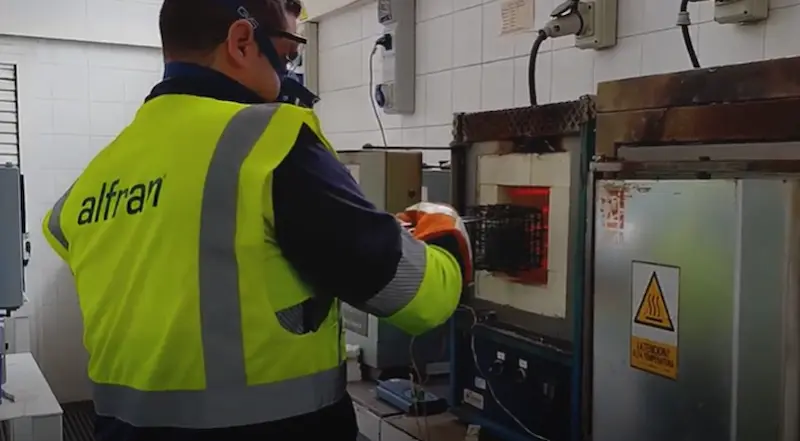
![Técnico trabajando con horno de laboratorio para ensayo de materiales refractarios]()
 Quality control and standardized testing
All our refractory concretes undergo a strict quality control system, from the reception of raw materials to delivery on site. We carry out tests in accordance with UNE and ASTM standards to guarantee resistance to compression, bending, thermal shock, and abrasion, among others.
This approach allows us to ensure that each solution provided meets the specific requirements of the customer and is adapted to the operating conditions of each industrial facility.
Technical training for staff: key to final quality
The final quality of the refractory lining depends largely on the experience and training of the technical team. For this reason, Alfran continuously invests in training its staff in technical aspects as well as safety, regulations, and best practices for installation.
This ensures that each project is executed according to criteria of excellence, reinforcing customer confidence and consolidating our position as a strategic industrial partner in innovative, tailor-made solutions.