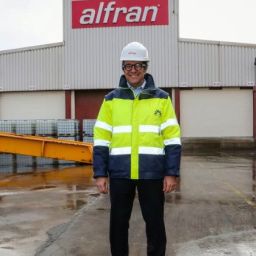
Braskem Idesa awards Alfran with a performance result of 100% in the third quarter of 2020. One more time, we are recognized for our performance in the works related to refractories and thermal insulation, that we have been installing in the petrochemical installation, located in southeast Mexico.
Related Posts
To combat the risks of accidents and damage to health, the application of technical and organizational measures is a priority. These measures are designed to eliminate risks at source or to protect workers through collective protection provisions.

When these measures are not enough, the use of personal protective equipment (PPE) is imposed. The PPE act fundamentally reducing the consequences derived from the materialization of the risk. The protective efficacy will depend on the adequacy of the individual protection equipment at the pre-existing levels of risk.
The correct selection and use of the appropriate PPE will minimize the consequences and damages should the risk materialize. Therefore, the mandatory use of them is of vital importance.
Awareness campaigns in Alfran
With the aim of raising awareness among all employees towards active behavior in the prevention of occupational hazards and advancing their integration at all levels, different Awareness Campaigns will be carried out during 2019.

For this, maximum involvement and collaboration is necessary, highlighting the members of the Health and Safety Committee, Delegates and Prevention Technicians, Intermediate Managers and Project Managers.
The Management and Prevention Department request the involvement of all to achieve the proposed objectives.
alfran® as a company with Corporate Social Responsibility has decided to fight to convert its workplace, gradually and starting with our headquarters in Spain, into “Smoke-Free” sites for the health of our employees and their families. This measure will apply to both enclosed and open places.
Continuing with the goalof converting Health and Safety into a VALUE for Grupo Aldomer, we emphasize the importance of safety when working at height.
In Spain, around 50 workers die each year from blows as a result of falls, being the third most common form of fatal accident during work hours (10%), behind non-traumatic pathologies (44%) and personal protective equipment ( 14%).
For the possible explanation and search for causes for this type of work accidents related to falls in height, we could find many different factors:
- Lack of training and information
- Use of personal protection equipment that is wrong or in poor condition.
In the specific case of working at height, worker training is essential, due to the complexity of the equipment intended for this purpose and its misuse; 25% of workers who at some point have to perform work with a risk of falling from a height, do NOT use the appropriate EPIS or PPE or use them in a scenario that requires a specific fall arrest system and with configuration and design parameters Associated with each situation. Depending on the Health and Safety campaign, we comment on the following:
Remember:
- Any work over 2 meters without effective protections (individual or collective) is prohibited.
- Hold the handrail on stairs and move carefully.
- Always keep 3 points of contact when using vertical ladders.
- The anti-fall PPE should only be used in cases where the protection of collective protections is not technically possible, since they do not prevent the materialization of the risk (fall in height), they simply reduce the consequences.
When using a harness:
- Adjust it properly. A badly placed harness can cause serious injury in the event of a fall.
- Check that it is in good condition and that it has no visible damage.
- Make sure you anchor to a sturdy point of sufficient height to stop the fall before impact. Whenever possible, do it above the head and on the same vertical, to reduce the drop factor and the pendulum effect.
- Do not jump between different levels.
- Do not run.
Before climbing a scaffold:
- Check that you have a green label with an effective date and follow all the indications reflected.
- Make sure the maximum scaffold load is adequate and respect it.
- Verify that the scaffold is not damaged and that it adapts to the needs of the work.
- Keep the hatch of the access ladder closed except when you are climbing or going down the stairs.
- Any modification of the scaffolding by personnel outside the specialized company that installs and certifies it is strictly prohibited.

Alfran is a specialist in designing, supplying and installing refractories for aluminum melting furnaces.
We have a wide range of refractory castables, such as Tix-80 NW, Drytech 85 AL, Tix 55AL or Cast-60AL, among others, specially designed for the aluminium industry, as well as our insulating castables, Lite 10/14 and Lite 106. We carry out new construction or maintenance projects. On the other hand, another company of Grupo Aldomer, Intec-Heat is specialized in the drying of refractories, in this type of furnaces.
We are available to our customers in the aluminum industry, to offer them, as we have done for more than 100 years, our Solutions in High Industrial Temperature.
At Alfran, we are proud to announce the opening of our new integrated refractory castables manufacturing plant in Perundurai, located in the state of Tamil Nadu, India. This facility will be our third integrated plant worldwide, joining our existing plants in Spain and Mexico, further strengthening our production capacity to meet growing international demand.
This strategic milestone marks a key step in our global expansion, reinforcing our commitment to innovation and proximity to our customers in the Asian market by providing high-value solutions and optimizing operational efficiency.
Boosting Efficiency and Competitiveness
With significant production capacity, this new facility will not only reduce response times and improve logistical efficiency for our regional customers but also become a key pillar in strengthening our presence in Asia and enhancing our global competitiveness.
Commitment to Sustainability and Local Development
The Perundurai plant has been designed according to strict European environmental standards. In addition, this project contributes to the economic development of the region by generating direct and indirect employment, as well as technical training of local workers by our EMEA experts.
At Alfran, we are committed to sustainable growth, innovation, and excellence in all our projects, consolidating our global leadership and strengthening our ability to deliver high-quality, innovative solutions to customers worldwide.
We would like to thank ABC de Sevilla for the interview with our Executive President, José María Domínguez, where he shares details about this important milestone.
Read the full interview on ABC de Sevilla: https://www.abc.es/sevilla/

In line with our commitment to ongoing training for clients, another series of sessions have been organized during the month of September. On this occasion, the sessions were held in Spain, with participants from different countries.
There were four days in which there was both theoretical and practical training. It began with a guided tour of the factory, to know the manufacturing equipment and sacking of materials. Additionally, the participants learnt about the manufacturing process for precast shapes.
After visiting the factory, the participants were also able to visit our laboratory, where they were explained some of the quality tests and the characterization of concretes, which we carried out in Alfran.
Following the dynamics of previous workshops, the participants had the opportunity to mix, vibrate, shoot and project via shotcrete, with their own hands, the different materials on a test panel.
Four days of training for the cement sector
Some of the subjetcs covered during these four days were the following:
- Theoretical training on joint systems.
- Theoretical training on the anchoring systems used.
- Alfran procedures: method of generation and implementation of Alfran procedures for the installation of refractories.
- Drying of refractories
- Planning of works in the cement sector.
- Thermographic analysis
- Theoretical training on Alfran Steel Tech materials technology.
- Gun-Mix systems: theoretical training of the application system and practice on the test panel. Explanation of the equipment and the factors that affect the installation of High Gun materials.
- Alfranjet installation system: theoretical training of the application system and practical training on the system assembly method. Practical training on test panels with explanation of the equipment and the factors that affect the installation of Alfranjet materials.
- Bricks installation system in a rotary kiln.
Of the training sessions, it is worth noting the commitment of the different collaborators. Multinational teamwork, Alfran Mode.

The National Association of Manufacturers of Refractory Products, Materials an Related Services (ANFRE) held in Seville, between March 11 and 14, the II Edition of Refractories Engineering Course.
It is a course taught by and for members of ANFRE that aims to train new generations of employees.
The course combines theoretical and practical training to obtain a global vision of the sector. In addition, the participants had the opportunity to visit both Siderúrgica Sevillana and our Alfran plant in Seville.
The following topics are found in the content of this course:
- Refractory materials
- Introduction to the design of coatings
- Refractory application
- Drying, heating and cooling
- Safety and Quality Control
From Alfran, we want to thank the entire Association for the organization of these courses.

In the dynamic and demanding industrial world, the need for safe and efficient solutions has never been more critical. Robotic demolition has become an essential tool for the modernization and maintenance of infrastructure across industrial sectors. These advanced technologies not only enhance the precision and safety of operations but also reduce execution times, manpower requirements, and associated costs.
Alfran, a leader in the supply and installation of refractory materials with innovative solutions for the industry, has embraced and refined robotic refractory demolition as part of its service offering. This commitment to innovation enables our company to tackle complex challenges and deliver optimal results to our clients. In this article, we take a closer look at what robotic demolition of refractories entails, its benefits, and some of Alfran’s notable success stories in this field.
WHAT IS ROBOTIC DEMOLITION?
Robotic demolition is an advanced method that uses remotely controlled robots to dismantle structures and materials. These robots are equipped with specialized tools such as hydraulic hammers, enabling them to carry out demolition tasks with unmatched precision and efficiency.
Unlike traditional demolition methods, which can be dangerous and less accurate, robotic demolition offers a range of significant advantages. Robots can operate in confined and hard-to-reach areas within industrial furnaces, where it would be risky for human workers. Moreover, their ability to handle heavy tools and perform repetitive tasks without fatigue leads to increased productivity and enhanced workplace safety when removing refractory materials.
BENEFITS OF ROBOTIC DEMOLITION
SAFETY AND EFFICIENCY
Safety is a key aspect. Robotic demolition significantly reduces the risk of injury by eliminating the need for workers to be in hazardous zones, particularly close to refractory linings. Robots are operated remotely from a safe location, allowing operators to supervise the process without exposure to danger—especially during hot refractory demolitions.
One of the greatest advantages of robotic demolition is efficiency. Robots can work continuously without breaks, significantly accelerating the demolition process. Their high precision also minimizes the risk of collateral damage to surrounding structures, which is critical in densely packed industrial environments.
ENVIRONMENTAL IMPACT
Robotic demolition also offers environmental benefits. These systems generate far less dust than traditional methods, contributing to a cleaner and safer work environment. Additionally, the precision of robotic demolition facilitates better recovery and recycling of refractory materials, supporting more sustainable practices.
ALFRAN’S SUCCESS STORIES IN ROBOTIC DEMOLITION
At Alfran, we have completed numerous successful projects using robotic demolition. These include work in preheater towers, furnaces, coolers, and other equipment in cement plants, as well as reverberatory furnace demolitions in the aluminum industry—all marked by a significant reduction in safety incidents and accidents.
In the steel sector, rolling mill furnace demolitions are common. Our robots accessed confined spaces and performed demolitions with a level of accuracy impossible to achieve using traditional methods. This not only led to faster completion times but also increased safety and reduced costs for our clients.
THE FUTURE OF ROBOTIC DEMOLITION AT ALFRAN
At Alfran, we are committed to the continuous innovation of our robotic demolition techniques. Our investment in research and development keeps us at the forefront of technology, ensuring we can offer our clients the most advanced and efficient solutions available. In addition to conventional robotic demolition equipment, we have developed our own CASTBREAKER system—a breakthrough solution for vertical equipment demolition that eliminates the need for scaffolding and uses only hoisting.
Furthermore, the ongoing training and development of our personnel ensure our operators and technicians a
The WRA (World Refractory Association) has uploaded a video explaining the importance of refractory materials in our day to day. It is a very illustrative video for those people who do not know the strategic aspects of this sector.
Did you know that our day to day life would be unimaginable if refractory products did not exist?
And, what are reafractory products?
Let’s take the example of a car: it is made with steel, copper, glass, aluminum and plastics, among others. These materials are manufactured at very high temperatures. For example, iron is melted in an oven and transformed into steel by processes that reach 2,000 °C. In order that the walls of the furnace are not affected by these temperatures, they have a coating of refractory material. In the same way, these coatings are also used for the manufacture of glass, copper, aluminum and plastics.

And how do you get refractory materials to withstand such high temperatures? What are they made of? And how are they manufactured?
It starts from diverse raw materials of alumina or magnesia base that are baked in special ovens up to 1,800ºC, and this process makes the refractory properties appear. The refractory material can be supplied as non-conformed or shaped.
How are these refractory materials used?
The refractory material is transported and installed in the facilities of our customers. For the installation, a specialized refractory company is required.
And, how long can these installed refractory materials withstand such high temperatures?
The life time of the coatings usually depends on the industry, since they work at different temperatures. In the steel industry, the material usually lasts from a few hours to a few weeks, while in the glass industry it can last up to 10 years.
Once the coating has worn out, it is removed and recycled when possible.
The refractory industry covers the entire cycle, from the extraction of raw materials, to recycling.

Visit the WRA website (World Refractory Association) by clicking here.